
TRANSFERENCIA DEL CONOCIMIENTO

Transfer approach de transferencia

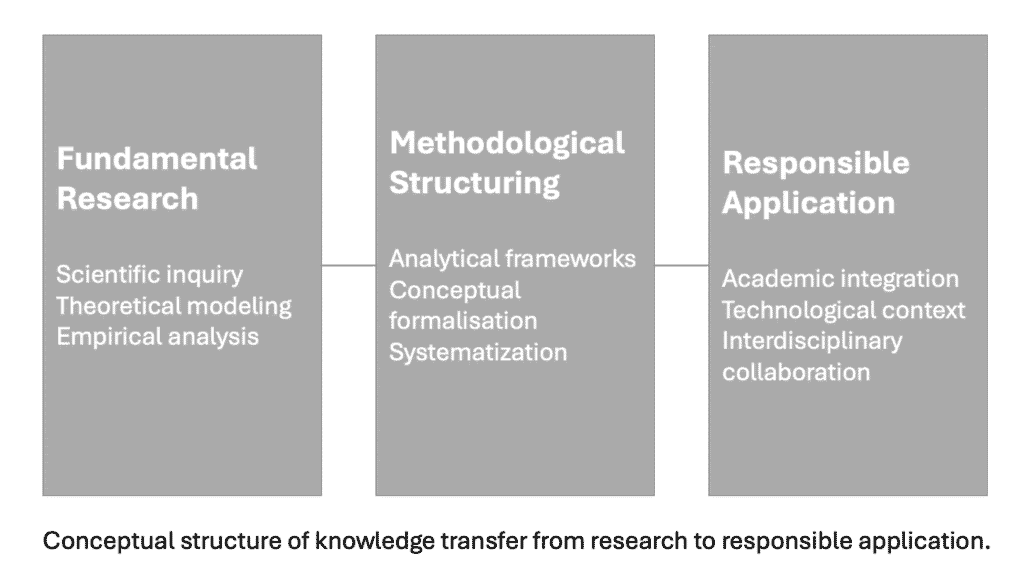
The CRAI conceives transfer as the structured articulation between fundamental research and responsible scientific application.
Its approach is oriented toward the formalisation of analytical frameworks capable of describing complex biological systems from an integrative and multicomponent perspective.
Transfer does not imply the direct commercialisation of products, but rather the methodological consolidation of knowledge that can be applied in academic, technological, or productive contexts under criteria of rigour, coherence, and conceptual traceability.

Collaborations

The CRAI establishes collaborations with academic institutions, research centres, and technological entities interested in the joint development of models, methodologies, and analytical criteria applicable to complex biological systems.
Collaborations are formalised through specific agreements and respect the scientific autonomy of the centre.
Scientific transfer

The CRAI develops models oriented toward:
The understanding of regulatory dynamics in interdependent biological systems.
The integration of evolutionary perspectives into the analysis of neurobiological profiles.
The study of integral phytochemical configurations is understood as functional units of biological analysis.
These developments provide conceptual frameworks that can be incorporated into academic projects, critical reviews, and interdisciplinary research programs.

Methodological Transfer

The centre contributes to the structuring of methodological tools for:
The structural and functional characterisation of whole plant matrices.
State-dependent analysis of interventions based on integrated biological systems.
The design of approaches that connect human biology and the ecological environment under systemic criteria.
The objective is to generate replicable methodologies that enable the evaluation of complex configurations without reducing them to isolated components.

Technology transfer

The CRAI participates in processes of:
Comparative systematisation of phytochemical profiles.
Conceptual evaluation of multicomponent formulations.
Definition of scientific criteria applicable to the responsible development of complex plant matrices.
All technological collaborations are framed within principles of scientific independence and methodological grounding.

This website uses cookies of its own and third - for correct operation and for analytical purposes. Contains links to third-party websites with privacy policies, which you can accept or not when you run them. By clicking the Accept button, you agree to the use of these technologies and the processing of your data for these purposes.
Privacy