
STRATEGIC FRAMEWORK 2026–2030
General Orientation
The present Strategic Framework defines the institutional priorities for the period 2026–2030.
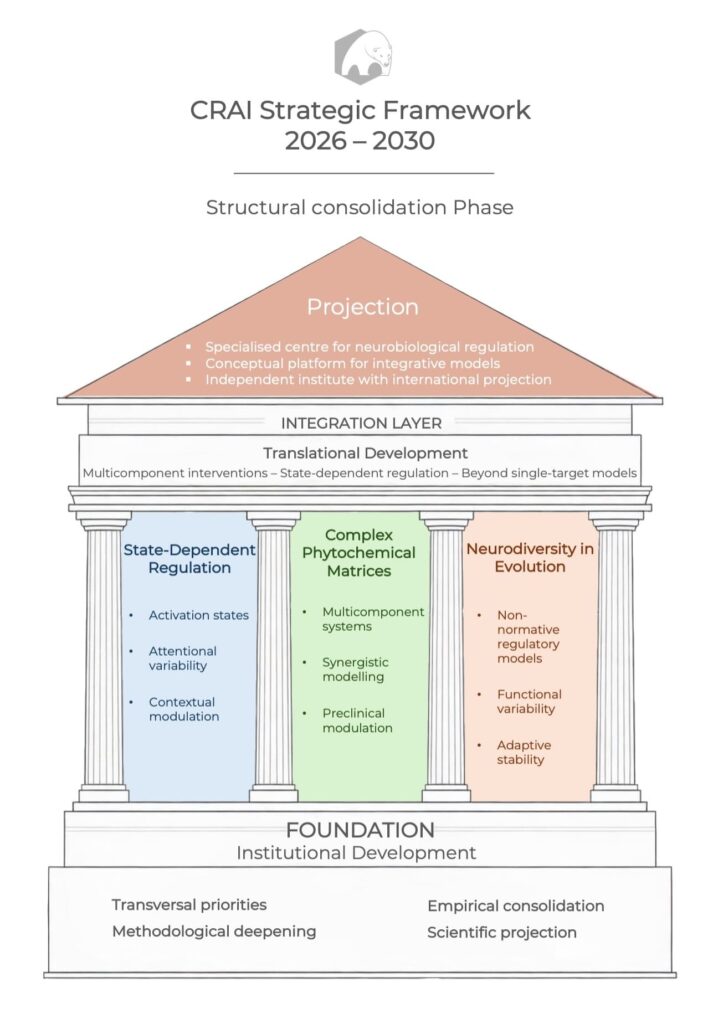
These priorities apply transversally across CRAI’s research lines, guiding their methodological deepening, empirical consolidation, and scientific projection.
Institutional Development
During the strategic period, the CRAI will prioritise the systematic production of indexed publications, the development of proprietary experimental protocols, the establishment of selective scientific collaborations, and its consolidation as an independent specialised node in neurobiological regulation within an ecological context.
Strategic Research Priorities
State-dependent regulation
Development of models that explain behavioural and cognitive fluctuations as a function of dynamic regulatory states, including the analysis of neurophysiological activation, attentional variability, and contextual modulation.
Development of models that explain behavioural and cognitive fluctuations as a function of dynamic regulatory states, including the analysis of neurophysiological activation, attentional variability, and contextual modulation.
Complex phytochemical matrices
Study of multicomponent plant systems through phytochemical characterisation, analysis of functional synergies, preclinical evaluation of modulatory effects, and modelling of organism–matrix interactions.
Study of multicomponent plant systems through phytochemical characterisation, analysis of functional synergies, preclinical evaluation of modulatory effects, and modelling of organism–matrix interactions.
Neurodiversity in an evolutionary context
Construction of explanatory frameworks that integrate profiles such as ADHD, ASD, and mixed configurations within non-normative regulatory models, with an emphasis on functional variability and adaptive stability.
Construction of explanatory frameworks that integrate profiles such as ADHD, ASD, and mixed configurations within non-normative regulatory models, with an emphasis on functional variability and adaptive stability.
Translational Development
Establishment of scientific foundations for regulatory interventions grounded in complex biological systems, prioritising multicomponent and state-dependent approaches over single-target models.
Establishment of scientific foundations for regulatory interventions grounded in complex biological systems, prioritising multicomponent and state-dependent approaches over single-target models.
Projection
The 2026–2030 period is conceived as a phase of structural consolidation, aimed at strengthening internal coherence, the progressive accumulation of knowledge, and international scientific projection. The CRAI aspires to consolidate itself as:
A specialised centre for research on neurobiological regulation within an evolutionary framework.
A conceptual platform for integrative models of human variability.
An independent institute with international projection and a scalable strategic orientation.
Strategic Declaration
A rigorous understanding of human variability requires the integration of evolutionary biology, neurophysiological regulation, and ecological systems within coherent and verifiable analytical frameworks.
The CRAI directs its development toward the progressive construction of this framework through cumulative and methodologically robust research.
The CRAI directs its development toward the progressive construction of this framework through cumulative and methodologically robust research.